2 Introduction
Resource efficiency includes energy efficiency and material efficiency strategies. It is an essential part of our response to decarbonisation. This is because we have limited supply of low-carbon energy and low-carbon materials — we cannot solve the problem just by swap-in solutions like renewable energy — so using them efficiently is essential.
There are many stages in the journey from primary energy sources (e.g. fossil fuels and renewable resources like wind) to the useful energy we need for end-uses such as cooking, cleaning, lighting, and transport. In the sections below we will break this down, so that we can consider the effect of changes at each stage.
2.1 Stages of energy use
Energy use starts with primary energy sources, such as coal or renewable electricity. These sources must generally be processed and transformed before they are used, for example by refining oil into petrol and diesel, or by generating electricity in a power station. The energy in this form is then known as final energy.
However, due to the nature of the ways that we use this energy, only a fraction of this final energy is actually used to do something useful: not all of the chemical energy in the gas going into a boiler ends up heating the house (some goes out the flue); not all the electrical energy going into a lightbulb ends up as light (some becomes heat), and so on. This useful energy is called… useful energy.
The final stage is to connect this useful energy to the service being delivered by it. The “service” is the the useful result which is brought about by using energy. For example, in a car, the engine converts fuel (final energy) into kinetic energy in the drive train (useful energy), but this is does not actually achieve anything unless the engine is located within a car, which we can sit inside and carry luggage in while being protected from the elements. The car is the passive system which actually delivers the service of “passenger transport”. Another example is a heating system (the conversion device, converting chemical energy in the gas into heat energy in the radiator), which is not useful unless the radiator is contained within an insulated space that can heat up and be comfortable (the passive system).
Figure 2.1 shows these stages of transformation.
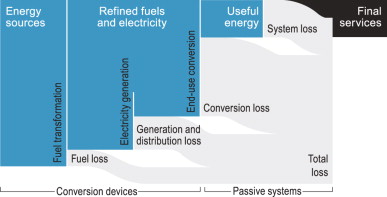
Examples of conversion devices are: electric motors, diesel engines, lightbulbs. They convert one form of energy (e.g. electricity or chemical energy) to another, more useful form (e.g. rotational kinetic energy or light).
Examples of passive systems are: the machine being driven by the electric motor; the rest of the car apart from the diesel engine; the room which is lit up by the lightbulb.
2.2 Defining energy efficiency
There are opportunities to improve energy efficiency at both of the stages shown in Figure 2.1. To quantify this, we define parameters describing the efficiency of the conversion devices and passive systems:
The conversion device efficiency, denoted here as \(\eta_D\), is defined as the quantity of useful energy produced by the conversion device for each unit of final energy consumed. Because it is a ratio of two energies, it is a dimensionless quantity measured in %.
The passive system energy intensity, denoted \(e_P\), is defined as the quantity of useful energy needed to deliver a unit of service.
Because the units used to measure different types of energy service vary, the energy intensity is described in different ways for different passive systems. For example, a car’s energy intensity can be measured in “kJ per kilometer driven”, while for trains, it’s better to measure it in “kJ per tonne transported per kilometer”.
2.3 Linking service, final energy demand, and GHG emissions
Assuming we want to achieve a certain fixed level of service delivered, say \(S\), using a given type of passive system and conversion device, which consumes a specific type of final energy. The quantity of final energy \(F\) needed to deliver this service is:
\[ F = \frac{S \; e_P}{\eta_D} \tag{2.1}\]
This follows directly from the definitions of \(e_P\) and \(\eta_D\) above.
2.3.1 GHG emissions from energy use
Producing and using energy results in greenhouse gas (GHG) emissions. The quantity of GHG emissions associated with using a unit of final energy a specific source is called the emissions intensity factor of that energy source, denoted here as \(\beta\).
Emissions intensity is measured in units such as “kgCO2e per kWh” (or, equivalently, “tCO2e/MWh”, “ktCO2e/GWh”, or “MtCO2e/TWh”).
So, Equation 2.1 can be expanded to find the quantity of GHG emissions \(E\) caused by the use of final energy \(F\), driven by the ultimate demand for an energy service \(S\):
\[ E = F \beta = \frac{S \, e_P \, \beta}{\eta_D} \tag{2.2}\]
These emissions intensity factors \(\beta\) can be estimated using data published by DEFRA (see Chapter 3).
2.3.2 Opportunities to reduce GHG emissions from energy use
Equation 2.2 shows us the options we have to reduce emissions associated with energy use.
We can use reduce the emissions intensity of the form of energy we are using, by improving the way it is generated, or by switching to an alternative fuel or energy carrier:
\[ \Delta E = F \Delta \beta \tag{2.3}\]
We can improve (increase) the efficiency \(\eta_D\) of the conversion devices used to convert final energy into useful energy, from an original value of \(\eta_0\) to the improved value \(\eta_1\):
\[ \Delta E = F \beta \left( \frac{\eta_0}{\eta_1} - 1 \right) \tag{2.4}\]
We can improve (reduce) the energy intensity \(e_P\) of the passive systems, which actually provide the end service from the converted useful energy, from an original value of \(e_0\) to the improved value \(e_1\):
\[ \Delta E = F \beta \left( \frac{e_1}{e_0} - 1 \right) \tag{2.5}\]
(these relationships are derived in Appendix A).
2.4 Material efficiency
Not all emissions are directly associated with using energy to provide final services. About a quarter of global emissions come from producing materials, components and products themselves. This is because the processes which make import materials such as steel intrinsically involve the production of GHG emissions.
We can think about material efficiency in a somewhat similar way to energy efficiency. There are opportunities to:
- produce the same amount of material with fewer emissions
- convert material into components and products with less waste
- use material more intensively in products, e.g. by re-using them, or keeping them in use for longer
Reffkit may be expanded to include more resources on material efficiency in the future, but for now, the free online book Sustainable Materials: With Both Eyes Open (Allwood and Cullen 2012) is a good place to find out more.